
Update 035.
Is Kickstarter Still Worth it?

I will never forget when I discovered Kickstarter. The premise was beautiful. True democratic design in practice. Anyone could develop a product, launch a campaign and raise funds directly from the people who wanted it - crowdfunding the capital needed for production, bypassing traditional investors and licensing models. It ripped up the playbook. The barrier to entry had dramatically reduced and, for the first time, creatives had the power.
I was in my second year of university. An aspiring product designer watching people around the world launch exciting products and build communities around them overnight. The energy was palpable. I knew back then that I wanted to launch my own product through Kickstarter one day.
I still remember the first kickstarter campaign I backed. It was back in 2016 and the concept was simple: Why can’t we repair headphones? Rarely is it the components that fail - it’s almost always the housing. What if you could 3D print the housing?
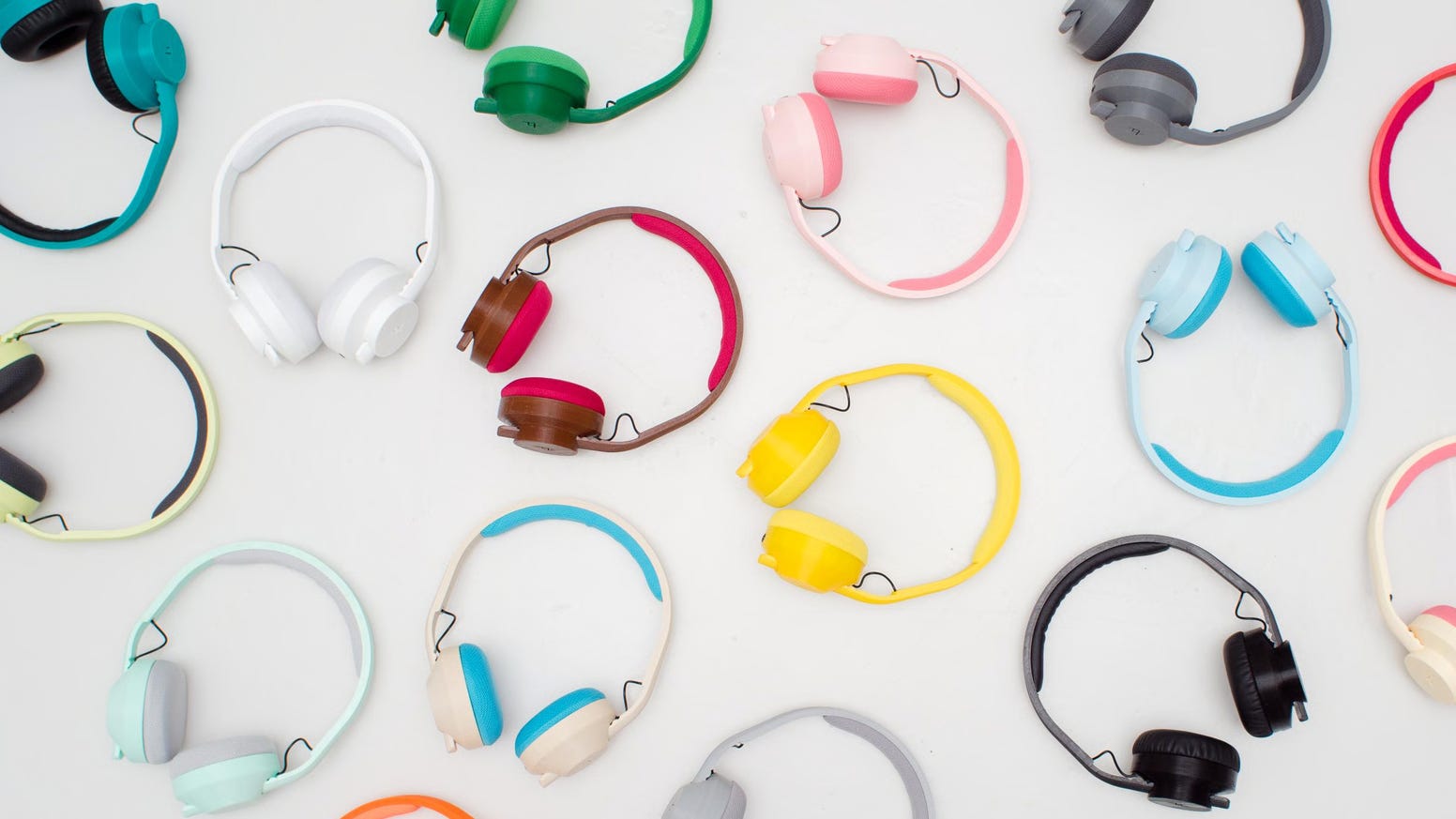
A DIY headphone kit produced by Print+ - a group of designers from the Netherlands. The product didn't ship on time (what Kickstarter project has?), but that didn't matter. The behind-the-scenes updates, the stumbling blocks shared openly, the clear passion behind every message - it was here I understood the real power of Kickstarter. Not just funding. Community.
During my Masters degree in 2014, I worked with a local design consultancy specialising in developing Kickstarter projects. One piece of anecdotal wisdom stuck with me ever since:
If your campaign doesn’t hit its funding target within the first 24 hours, its chances of hitting that target approach zero.
The algorithm had long prioritised campaigns with rapid early traction.
Careful planning, months of pre-launch hype, customers primed and ready to buy on day one - this was the reality even then. But it wasn’t really an issue until large organisations began to play.
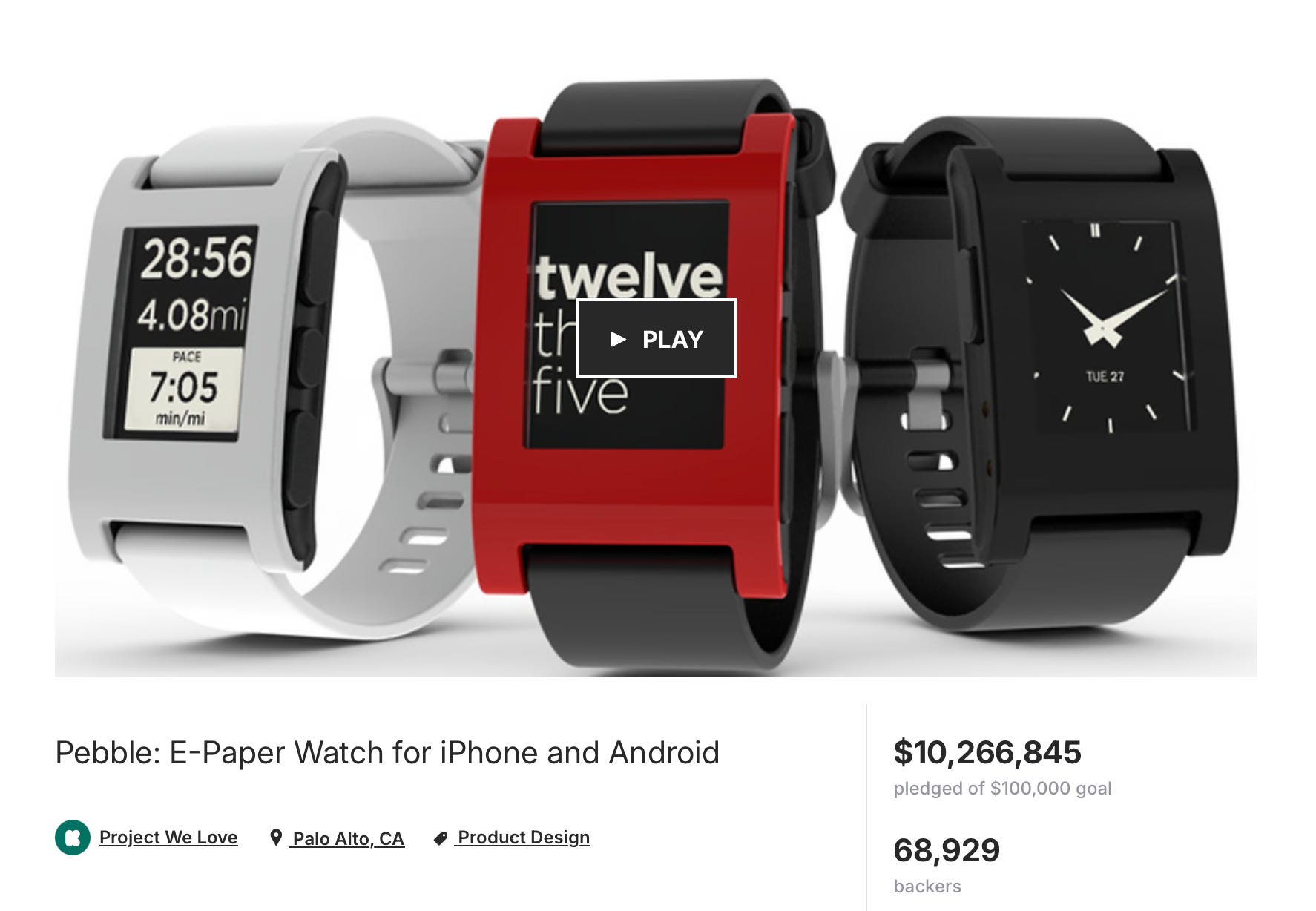
The dynamic shifted entirely. Away from a model where funds raised would define whether a product was realised at all, towards a model of marketing and promotion for products that will launch regardless. It moved from a platform that enabled something like Pebble - $10 million raised by a founding team of just 10 people - to a platform where Anker, a company with a turnover exceeding £2 billion, launched Kickstarter’s highest funded project of all time.
The childlike excitement I had when I first discovered Kickstarter - the infinite potential - vanished. There was a large barrier to entry again. It wasn’t a simple as having a production ready, exciting product and a good story to tell anymore. Now you needed:
A pre-built email list of at least 1,000 warm leads - before launch day
6-12 weeks of pre-launch runway, running paid ads to build the list
A £10,000 - £15,000 advertising budget - before you’d sold a single product
A professional campaign video that hooks someone in under 30 seconds
A PR agency to get press coverage at exactly the right moment (and a budget for paid product placement)
A crowdfunding marketing agency to manage your funnel, ad spend, and conversion rates across your campaign.
A pledge manager, a fulfilment partner, and a shipping strategy
I had none of that.
When I made the decision to launch Mμ back in 2021 following over a year of prototyping, I did so in the knowledge that I would be doing it all myself and on a shoestring budget. I launched my social accounts and began sharing behind the scenes development, testing the water and gauging interest. I spent a grand total of £100 on ads. Instead, I focussed my energy on reaching out to publications and influencers I felt were genuine and was incredibly surprised when so many responded. Having commissioned a small batch of production samples with my production partner, I sent these samples out to as many influential people as I could afford to - keeping only one final set for myself to film my campaign video. This translated into a brilliant review on CoffeeGeek and some incredible promotion by a few smaller coffee influencers. This grew my email list to just under 300 warm leads before launching (a fraction of what is recommended). I primed them as best I could, reduced my funding target as far as I could personally subsidise, and pressed the launch button.
Mμ was funded in just under 4 hours. It raised 12x the funding goal.
Over 500 projects now launch on Kickstarter every single day. The algorithm rewards whoever arrives with the biggest pre-built machine behind them. It took me years to get a place where I was comfortable with this to launch Mμ and honestly - I wasn’t sure I would ever launch a second campaign.
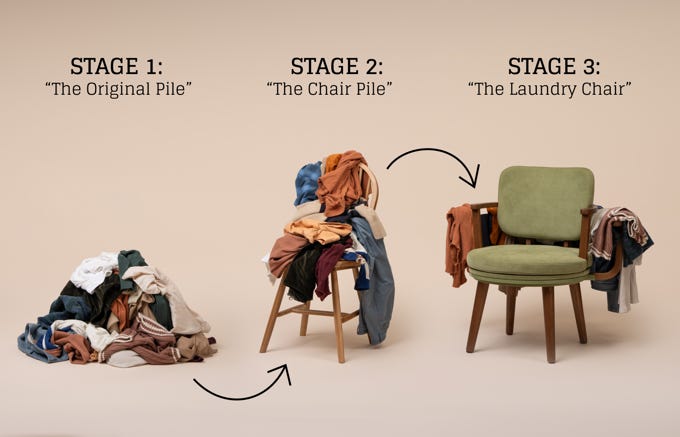
Seeing Simone Giertz recent kickstarter success with her Laundry Chair (raising nearly £1 million!) gave me hope. I have long admired Giertz’s candid voice and ability to build community and this project was a signal - the soul of the platform, briefly, unmistakably visible.
I’m starting to the rethink running a second campaign. Eyes open, clear about the work involved and what I'm up against.
I try to be as open as possible here. Read on to see what I'm considering launching - and I'd love to hear your thoughts.
A Small Ask
Did this months focus resonate with you? Do you own one of my products? Can I kindly ask you to consider writing a review on my website? Your feedback helps others trust in my little brand. It only takes a minute and means the world.
Want to listen to this update as a podcast?
Try listening to this month’s update as a podcast below and let me know what you think. I have been testing the water with notebooklm for a year now and it keeps getting better.
Don’t forget, help me to spread the reach by getting your friends and family to sign up below :)
My Products, My philosophy
I find myself more driven than ever to put thoughtful, meaningful products out into the world that don’t compromise on quality. The type of products people want to own and help in some way.
I want to design products that intentionally take us out of auto-pilot. That incense holder that sits next to you throughout the day, reminding you to take a break. The coffee cup that feels just right in the hand and encourages you to savour every sip.
Objects designed to help you notice the moments you’re in. Support a small independent designer :)
I’m down to my last few sets of Mμ and Laminar with no plans to restock soon, so get yours while stock lasts.


As a thank you, you can use this discount code at checkout (available site wide): SubstackCrew (10% off).

Last months most clicked link: Build your own Eames House.
My top 5 pieces of content I have found helpful/inspiring:
1.
The Layup Chair by Nathan Martell. With Milan Design Week this month, my feed has been full of furniture. Nothing has stopped me mid scroll faster over the last year than this design. It defies everything I know about bent lamination and is stunning in its simplicity.
2.
Why Kids need to take more risks. Brilliant TED talk on the value of risky play for kids and what we have lost by sanitising playgrounds.
3.
NASA’s Plan for the Moon. Who was captivated by the NASA’s Artemis launch! We need more hope in the world and this was incredible. More incredible still is what lies ahead!
4.
IKEA’s Inflatable Chair. Another chair launched at Milan Design Week and the strongest signal yet that playful design is back!
5.
Design Trends 2026. I’m a big believer in Macro trends - less so in fast moving micro (aesthetic) trends but Gray’s video’s always bring a smile. Well worth a watch.

A Guest Writer
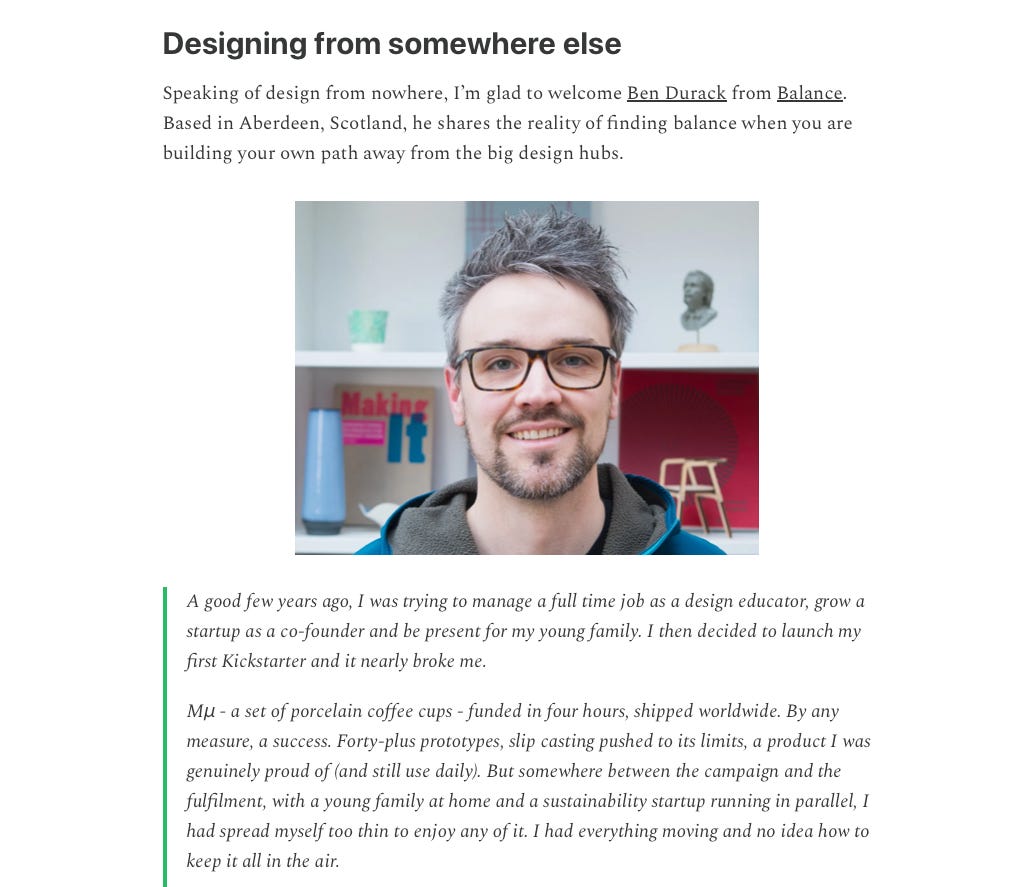
I had this privilege this month of guest writing for Mario Alessiani’s substack. As a designer based in a small town in Italy, Mario is proving that geography isn’t as critical to success as it used to be - something I resonate hugely with. The community here on substack is something I have come to value hugely!
Check out Mario’s latest post here: Designer from Nowhere
A Second Kickstarter?
There’s a Japanese word - sundoku (積ん読) - for the phenomenon of buying books with every intention of reading them, then watching them pile up untouched. It’s so universal it has its own name.
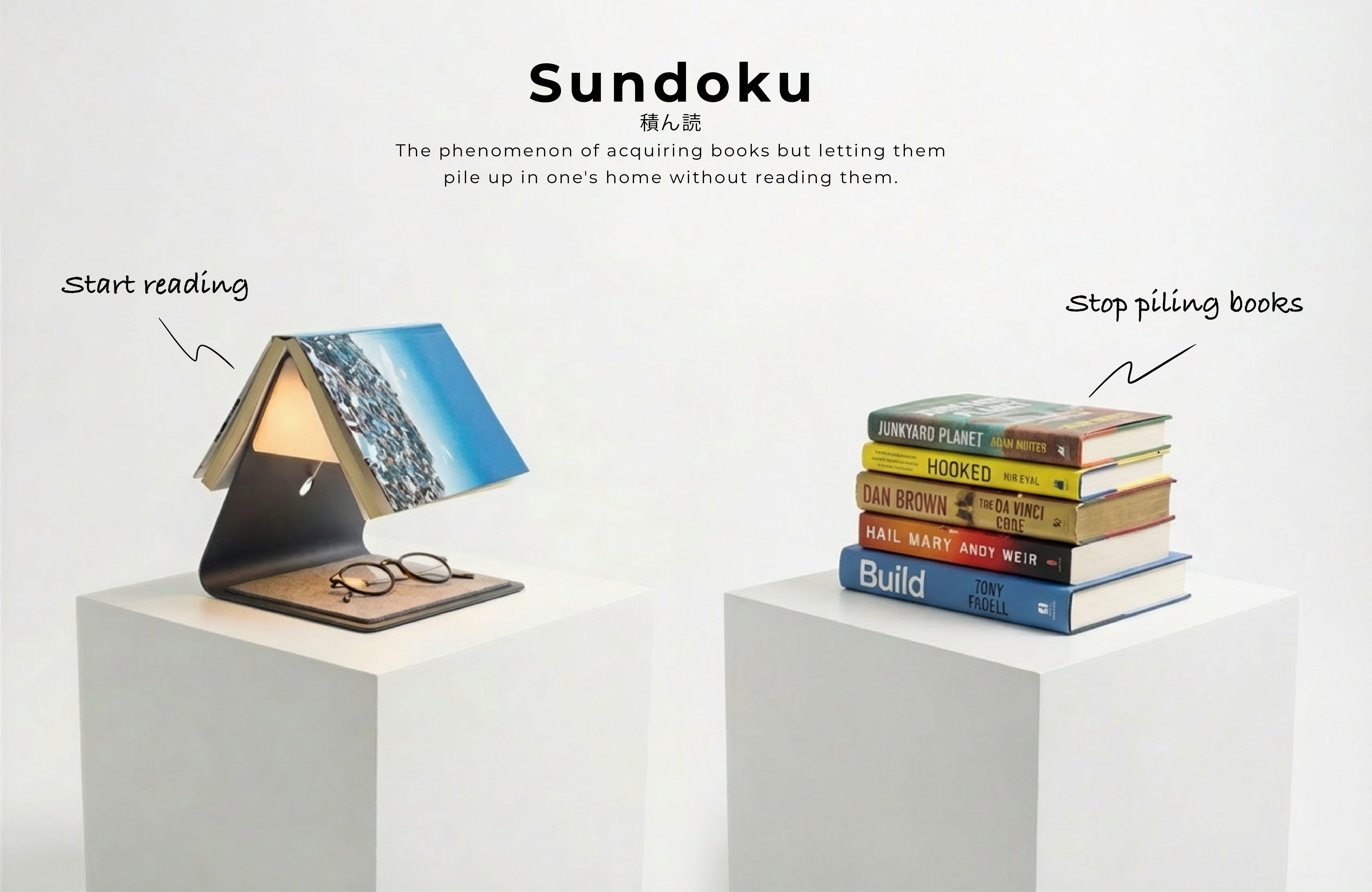
I am a chronic sundoku sufferer. And a few years ago, that recognition became the seed of something I haven’t been able to let go of since.
The lightbulb moment
I was reading Atomic Habits when I landed on the idea of “habit stacking” - building new habits onto existing ones rather than starting from scratch. Something clicked. What if your bedside light only turned on when you lifted your book? What if the book itself was the switch?
The idea arrived fully formed. I sketched and tested as fast as I could - I needed to see it! I knew immediately what it needed to be:
Designed to make reading the easiest decision you make before bed.
That’s Sundoku. A bedside lamp that responds to your book — not your phone.
We’ve had two working prototypes in our house for years. Slowly refined, made better, lived with. And of all twelve products I developed and shared in my first year on Substack, this is the one I keep coming back to.
So what’s changed?
Presence
The original form was always driven by production constraints (powder-coated, laser-cut, folded sheet metal). Low-volume friendly, honest and premium feeling. I still believe in that approach.
But I’ve been questioning how much of the metal needs to be visible. The original silhouette is something I genuinely love - simple, considered, a little architectural. I’ve been exploring a revised form that reduces the visual weight of the metalwork.


I’d love to know which lands better for you?
Reliability
A product like this only works if it feels like magic. The magic disappears the moment the light doesn’t turn on.
My original switch mechanism (shared back in update 023) worked well for a few months before becoming inconsistent. I was keen to keep things simple - no complicated electronics, nothing that would push the cost up. Inconsistency isn't an option when the whole point is the moment. So I kept testing.
Over the last few weeks I’ve been testing a time-of-flight sensor (miniature radar using infrared lasers). It’s a more complex setup that requires a microcontroller to run it, but that complexity has opened unexpected doors. The light can now fade slowly once the book is placed back down, giving you a few quiet moments to settle before darkness. That feels right.
Two years ago this would have taken me weeks to develop. AI tools have changed something fundamental about how I build. I’ve used Arduinos for years but my coding was never fluent enough to simply make what I imagined. That limitation is gone. I’m no longer bounded by what I can code. I’m only bounded by my own creativity. I still need enough understanding to troubleshoot but the ceiling has lifted dramatically, and I think that matters beyond just this project. It means designers like me can close the gap between idea and realisation in ways that simply weren’t possible before.
Next step: making my own circuit board to permanently connect each component, then re-housing everything inside Sundoku. Watch out for the next update!
So… a Kickstarter?
Licensing was always my instinct for Sundoku. The complexity of bringing it to market pointed toward a brand partnership, and I’ve quietly developed pitch materials for brands I feel are genuinely aligned. But cold outreach has its limits, and the longer I sit on this, the more I think Kickstarter might be the right move.
There’s a clear niche. A clear need. A product that needs to be experienced to be understood - which is exactly what a well-made campaign video can do. I can see the campaign. I can see the community of book lovers and habit-seekers it would reach. I have some production partners already identified.
What I’m honest about is the weight of doing it alone. A campaign needs capital to engage production partners, time to build an audience before launch, and the full commitment of seeing it through to fulfilment if it succeeds. I’m not afraid of hard work. But I’m deliberately careful about where I point it.
This felt like the moment to think out loud with you and I’d love to hear your thoughts.